Mechanical logs
Mechanical logs
MECHANICAL | FRAME | Date: JUNE 9
MECHANICAL | FRAME | Date: JUNE 9

What was accomplished
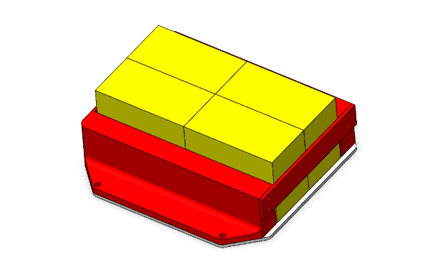
Following a decision to increase the drone's onboard power capacity to meet this year's heavier payload and longer mission-time requirements, the mechanical department upgraded the lower deck from a two-battery to a four-battery configuration, requiring an entirely new holder design. The new custom 3D-printed holder encloses the four battery packs (143mm x 108mm x 75mm each) across three sides using 15mm-thick walls, arranged in a densely packed, two-row configuration with zero clearance between them to prevent internal shifting or impact damage. One wall features a bottom gap for wire routing, while the two lateral walls are reinforced with structural ribs to support the added weight of the larger battery cluster.
The department also redesigned the holder's standoff-locking slots to match the larger footprint, refining their geometry to hug the lower deck's vertical standoffs with a tight, form-fitting tolerance. This ensures the larger battery tray seats flush against the standoffs and remains rigidly locked in place, with no reliance on any separate gate, strap, or fastening hardware.
Challenges and solutions
The main challenge was fitting twice the battery volume into the same lower deck footprint without exceeding the drone's central structural boundaries. This was resolved by arranging the four packs into a tightly packed two-row configuration and increasing the wall thickness to 15mm, with large triangular ribs added to the side walls to prevent flexing or cracking under the added weight and high-G maneuvers.
A further challenge was ensuring the redesigned standoff-locking slots gripped tightly enough to fully eliminate movement under high-frequency flight vibrations, despite the increased mass of the four-battery cluster, without making the holder difficult to install or remove during battery swaps. The team resolved this through iterative fit testing, adjusting the slot tolerances until the holder could be seated firmly by hand while still resisting any vibrational movement once locked in place.
Next Steps Plan
With the core frame and power housing complete, the mechanical department will run structural simulations on the current frame design to validate its performance under expected flight loads before moving to further design refinements. we also need to confirm this approach is the best for the UAV.
What was accomplished
Following a decision to increase the drone's onboard power capacity to meet this year's heavier payload and longer mission-time requirements, the mechanical department upgraded the lower deck from a two-battery to a four-battery configuration, requiring an entirely new holder design. The new custom 3D-printed holder encloses the four battery packs (143mm x 108mm x 75mm each) across three sides using 15mm-thick walls, arranged in a densely packed, two-row configuration with zero clearance between them to prevent internal shifting or impact damage. One wall features a bottom gap for wire routing, while the two lateral walls are reinforced with structural ribs to support the added weight of the larger battery cluster.
The department also redesigned the holder's standoff-locking slots to match the larger footprint, refining their geometry to hug the lower deck's vertical standoffs with a tight, form-fitting tolerance. This ensures the larger battery tray seats flush against the standoffs and remains rigidly locked in place, with no reliance on any separate gate, strap, or fastening hardware.
Challenges and solutions
The main challenge was fitting twice the battery volume into the same lower deck footprint without exceeding the drone's central structural boundaries. This was resolved by arranging the four packs into a tightly packed two-row configuration and increasing the wall thickness to 15mm, with large triangular ribs added to the side walls to prevent flexing or cracking under the added weight and high-G maneuvers.
A further challenge was ensuring the redesigned standoff-locking slots gripped tightly enough to fully eliminate movement under high-frequency flight vibrations, despite the increased mass of the four-battery cluster, without making the holder difficult to install or remove during battery swaps. The team resolved this through iterative fit testing, adjusting the slot tolerances until the holder could be seated firmly by hand while still resisting any vibrational movement once locked in place.
Next Steps Plan
With the core frame and power housing complete, the mechanical department will run structural simulations on the current frame design to validate its performance under expected flight loads before moving to further design refinements. we also need to confirm this approach is the best for the UAV.

DRAG Tactical Team
ENGINEER | NAVIGATE | DOMINATE
Quick Links
DRAG Tactical Team
King Abdulaziz university
Saudi Arabia
⌖ View on Maps
Visit Us
Quick Links
Quick Links
Visit Us
DRAG Tactical Team
King Abdulaziz university
Saudi Arabia
⌖ View on Maps
DRAG Tactical Team
King Abdulaziz university
Saudi Arabia
⌖ View on Maps
DRAG Tactical Team
King Abdulaziz university
Saudi Arabia
⌖ View on Maps