Designing the Carbon-Fibre Arms and Motor Mounts
Designing the Carbon-Fibre Arms and Motor Mounts
MECHANICAL | FRAME | Date: MAY 5
MECHANICAL | FRAME | Date: MAY 5

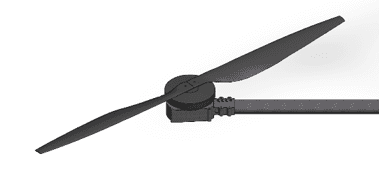

The mechanical department began the structural design of the quadcopter frame. The core architecture uses four carbon fiber tubular arms, labeled M1 through M4, extending directly from the central chassis to each of the four motor positions — a straightforward single-arm-per-motor layout selected for its structural simplicity and proven reliability.
The department then finalized the distal ends of the arm assemblies, carrying over the high-torque motor mounting concept proven on last year's platform. Custom-machined mounting plates were designed for the distal end of each arm, secured using a dual-clamp system — two clamps per arm — to maximize friction and completely eliminate any rotational slipping under heavy payload loads.
Challenges and solutions
The main challenge this week was ensuring the motor mounts could handle the torque and vibration loads of the drone's motors without any rotational slipping — a lesson carried over directly from prior testing. Since a single clamp had previously shown a tendency to loosen slightly under sustained heavy-load operation, the team upgraded to a dual-clamp system per arm, doubling the clamping surface area and dramatically increasing resistance to rotational movement under high torque.
Next Steps Plan
Design the top tier (upper deck) of the central frame. This will serve as the primary mounting foundation for securing the drone's arms and will be engineered to integrate fully with the overall chassis configuration.
The mechanical department began the structural design of the quadcopter frame. The core architecture uses four carbon fiber tubular arms, labeled M1 through M4, extending directly from the central chassis to each of the four motor positions — a straightforward single-arm-per-motor layout selected for its structural simplicity and proven reliability.
The department then finalized the distal ends of the arm assemblies, carrying over the high-torque motor mounting concept proven on last year's platform. Custom-machined mounting plates were designed for the distal end of each arm, secured using a dual-clamp system — two clamps per arm — to maximize friction and completely eliminate any rotational slipping under heavy payload loads.
Challenges and solutions
The main challenge this week was ensuring the motor mounts could handle the torque and vibration loads of the drone's motors without any rotational slipping — a lesson carried over directly from prior testing. Since a single clamp had previously shown a tendency to loosen slightly under sustained heavy-load operation, the team upgraded to a dual-clamp system per arm, doubling the clamping surface area and dramatically increasing resistance to rotational movement under high torque.
Next Steps Plan
Design the top tier (upper deck) of the central frame. This will serve as the primary mounting foundation for securing the drone's arms and will be engineered to integrate fully with the overall chassis configuration.

DRAG Tactical Team
ENGINEER | NAVIGATE | DOMINATE
Quick Links
DRAG Tactical Team
King Abdulaziz university
Saudi Arabia
⌖ View on Maps
Visit Us
Quick Links
Quick Links
Visit Us
DRAG Tactical Team
King Abdulaziz university
Saudi Arabia
⌖ View on Maps
DRAG Tactical Team
King Abdulaziz university
Saudi Arabia
⌖ View on Maps
DRAG Tactical Team
King Abdulaziz university
Saudi Arabia
⌖ View on Maps